Fixing damaged spray foam roofs
Foam roof repair in Sacramento, CA
A dent, bird peck, blister or open coating crack on your foam roof lets water into the foam, and the damage spreads every rain.
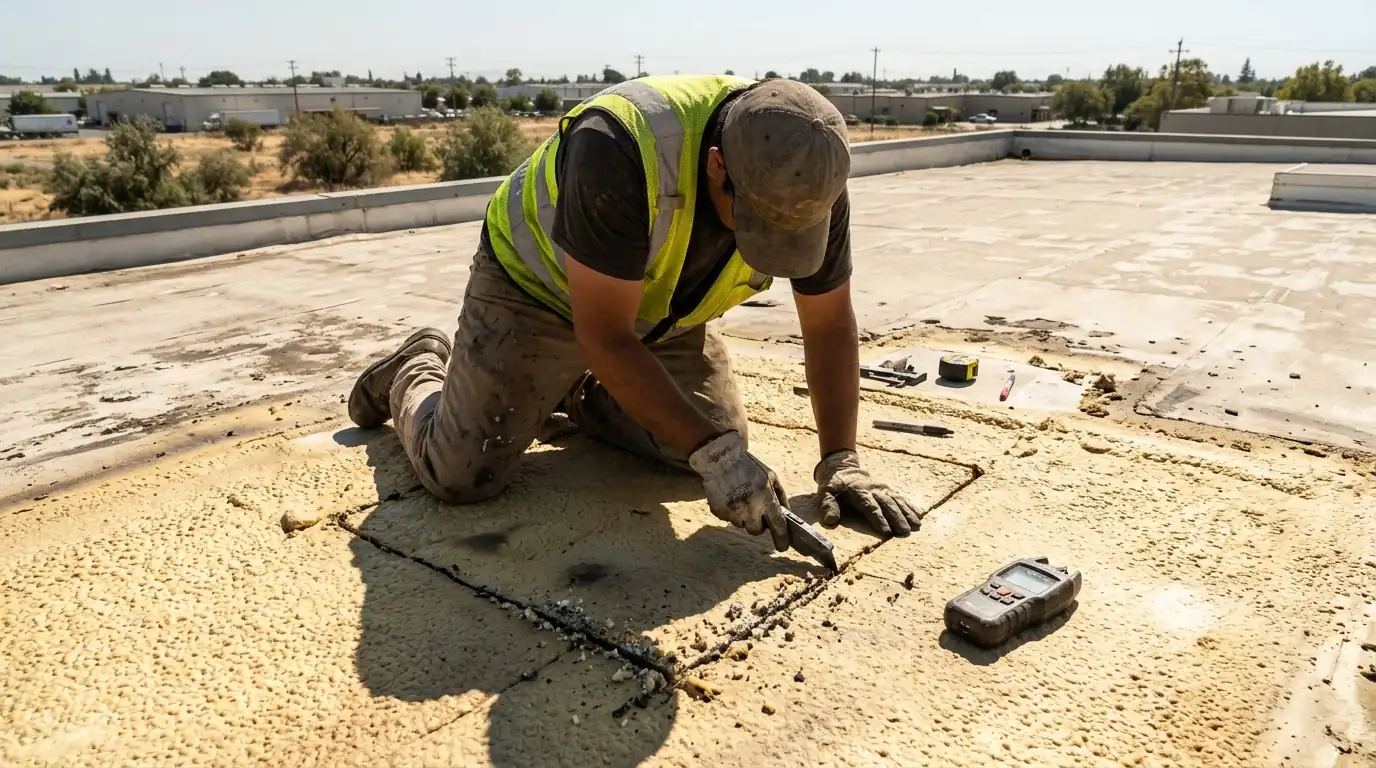
Foam roof repair means finding the damaged or wet area, cutting it out, spraying new closed-cell foam to match the surrounding thickness, and recoating the patch. Small repairs in Sacramento typically run 485 to 1,640 per job. Most spot repairs finish in one day when the weather window is dry.
What this job involves
Foam roofs fail in a few predictable ways. The coating cracks or wears thin and the foam beneath chalks. Birds peck holes in the surface. A dropped tool or hail dents it. Water gets into the foam through a cut and spreads sideways between lifts, which is why a small hole can hide a much larger wet patch. Because the foam is closed-cell, water travels slowly, but it never fully stops once it finds a path under the coating.
The key to a good repair is finding where water actually entered and how far it traveled. A foam roof does not leak where it shows a stain indoors, since water follows the foam layers. We probe, scan with a moisture meter and cut test cores before we spray anything. A repair that covers wet foam will blister and fail within a season. We show you the core samples and the moisture readings so you can see what is wet and what is dry before we price the work.
Signs your foam roof needs repair
Foam that feels soft underfoot has taken on water. Dry closed-cell foam is firm, so a spongy area usually means the cells are saturated and the patch must be cut out.
Birds and squirrels peck foam surfaces, leaving round holes. Each opening exposes uncoated foam to sun and water and should be filled and recoated soon.
Where coating has worn through, the yellow or tan foam turns powdery in the sun. Unprotected foam loses its surface in weeks, so patching should not wait.
Raised bubbles mean trapped moisture or gas under the coating. We cut one open to see if the foam below is wet, then repair the layer rather than just the bubble.
Roof edges, curbs and parapets flex with heat. Hairline coating cracks there grow into leaks, and are cheaper to seal early than after the foam is wet.
Brown rings under a foam roof point to a leak, but the entry point is often several feet away. Tracing the water path is the first step of repair.
How we find the real leak
Most failed foam repairs trace back to guessing. Water enters a foam roof at one point, then travels between lifts or along the deck before it shows inside. We start at the stain, work uphill and check every penetration, seam and edge. An infrared or capacitance meter shows moisture patterns, and a small core cut confirms whether the foam is wet or just damp on top. If the foam is wet, the repair is simple in principle: cut it out until you reach dry foam, then rebuild. If it is only the coating that has failed, a localized recoat may be enough. We tell you which case applies and show you the core, so the price matches the real problem rather than a worst-case guess.
- Moisture scan across the roof
- Core cuts to confirm wet foam
- Edge and curb inspection
- Photos of damage before repair
- Adhesion test on patch area
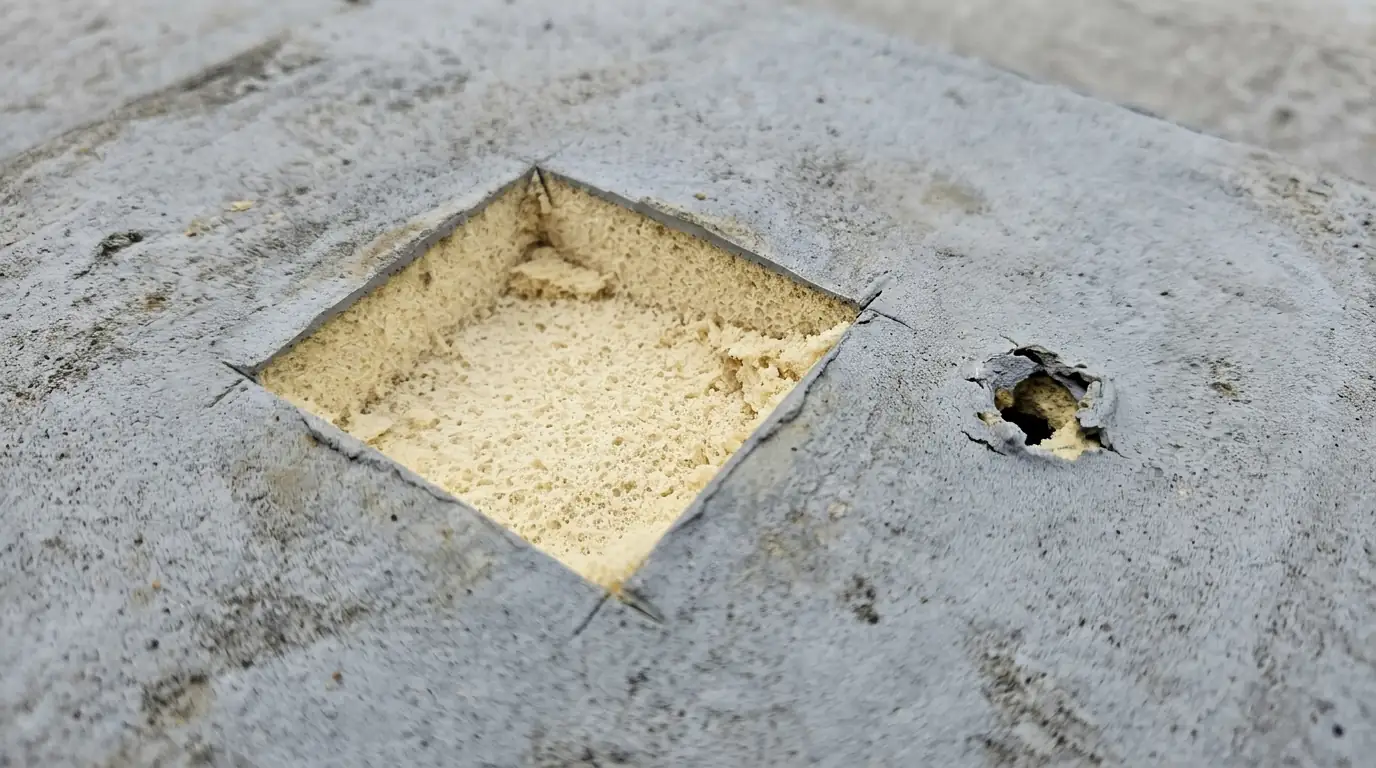
What a proper foam patch looks like
A good patch is cut square with clean edges, down to firm dry foam. The edges are beveled slightly so the new foam can lock in. We prime if the exposed surface is old or glazed, then spray new foam in lifts until it sits level with the surrounding roof, matching the density of about 2.5 to 3 pounds. The patch is then coated well past its edges. Overlapping the old coating by several inches creates a sealed joint instead of a ring where water can creep in. We aim for the same dry mil thickness as the rest of the roof, and we match the coating type already on your roof so the two cure and expand together in heat.
Mistakes that make repairs fail
Roof cement over a foam hole is the classic bad fix. It hardens, cracks in summer heat and traps water against the foam. Silicone sealant alone may peel off if applied over dusty foam. Spraying foam in damp weather or too soon after rain causes poor adhesion and blisters. Another mistake is repairing just the hole and ignoring why it opened. Birds return to the same spot, ponding water keeps wearing the coating, and cracked edges reopen. A lasting repair deals with the cause too, whether that is bird deterrent, a drain fix or a stronger coating at the edge.
Our process for foam roof repair
Six steps, in the order the crew does them on a Sacramento roof.
- Step 1Trace the leak path
We start at the interior stain, work uphill on the roof, and check penetrations, seams and edges to find where water actually gets in.
- Step 2Scan and core
A moisture meter maps wet zones and a small core cut confirms the foam condition, so we know how much to remove before we price the work.
- Step 3Cut out damaged foam
Wet or soft foam is cut out with beveled edges until we reach firm, dry material. We never spray over damp foam.
- Step 4Prime and respray
Old surfaces get primer if needed, then new closed-cell foam is sprayed in lifts until the patch is level with the existing roof.
- Step 5Coat past the edges
The patch and a wide margin around it are coated to match the roof's mil thickness, sealing the joint between old and new.
- Step 6Test and clean up
We water test where practical, check adhesion on the cured patch and clear all debris from the roof and drains.
What foam roof repair costs in Sacramento
A few pecked holes and one cracked curb on a residential foam roof typically cost near 780 to 1,150 for cutting, respraying and recoating.
- Size of wet or damaged area
- Access and roof height
- Coating type to match
- Number of separate repair spots
Compare this job with others in the Sacramento roofing cost guide.
Sacramento conditions that matter
Sacramento's heat is hard on foam coatings. Months of 100 F days swell and shrink the coating at edges and corners, and cracks often appear by late summer. Winter rain then finds those cracks, so late fall is the time to repair before storms. Trees matter too. Valley oaks and sycamores drop debris that holds water against foam, and woodpeckers and crows in neighborhoods like Land Park and East Sacramento peck at exposed spots. Roofs in the foothills near Auburn and Placerville face ember risk, so we check for coating burn marks after fire season and repair them promptly.
Often paired with this service
Foam Roof Recoating
Restoring the protective topcoat
View serviceRoof Leak Detection
Find the leak, not the stain
View serviceSpray Foam Roofing
Sprayed-in-place SPF roof systems
View serviceRoof Inspection
Know your roof's real condition
View serviceRead before you decide
Questions about foam roof repair
Can a small hole in foam roofing wait until next season?
Waiting is risky. Exposed foam chalks in sun and absorbs water in the first storm, which turns a small hole into a large wet section. A small hole is often fixed in under an hour, so repairing before November rain is almost always cheaper than waiting.
Why is my foam roof leaking if the coating looks fine?
Water usually enters at a small crack, edge or penetration and spreads inside the foam. The stain indoors can sit several feet from the entry point. Moisture scanning and core cuts find the true source, which is why we do not patch only where the ceiling stain appears.
Can you repair foam in winter?
Yes, when there is a dry window. Foam and coatings need a dry surface, moderate temperature, a dew point well below the roof temperature and no rain for 24 to 48 hours. We watch the forecast and use temporary sealing on emergency leaks, then finish the permanent repair when conditions allow.
Do you match my existing coating color?
We match the coating type first, since silicone, acrylic and polyurethane do not always bond well to each other. Color is matched as closely as the product line allows, though new coating over aged coating may look slightly different until weathering evens it out. White and light gray are the most common.
How do I know if bird damage is serious?
Round pecked holes that go through the coating into foam are the concern. If the holes are shallow and few, a patch is enough. If birds keep returning, we add deterrents such as spikes or reflective devices. Probing the holes tells us whether water has already reached the lower lifts.
Roof leaking, peeling or baking in the sun?
Call the 24/7 line. Tell us the roof type, where the water shows up or what the coating looks like, and we will tell you what we would check first and when a crew can be there.