White heat-welded single-ply membrane
TPO roofing in Sacramento, CA
TPO reflects valley sun and welds into one continuous sheet, but only if the seams, deck and flashing details are done properly.
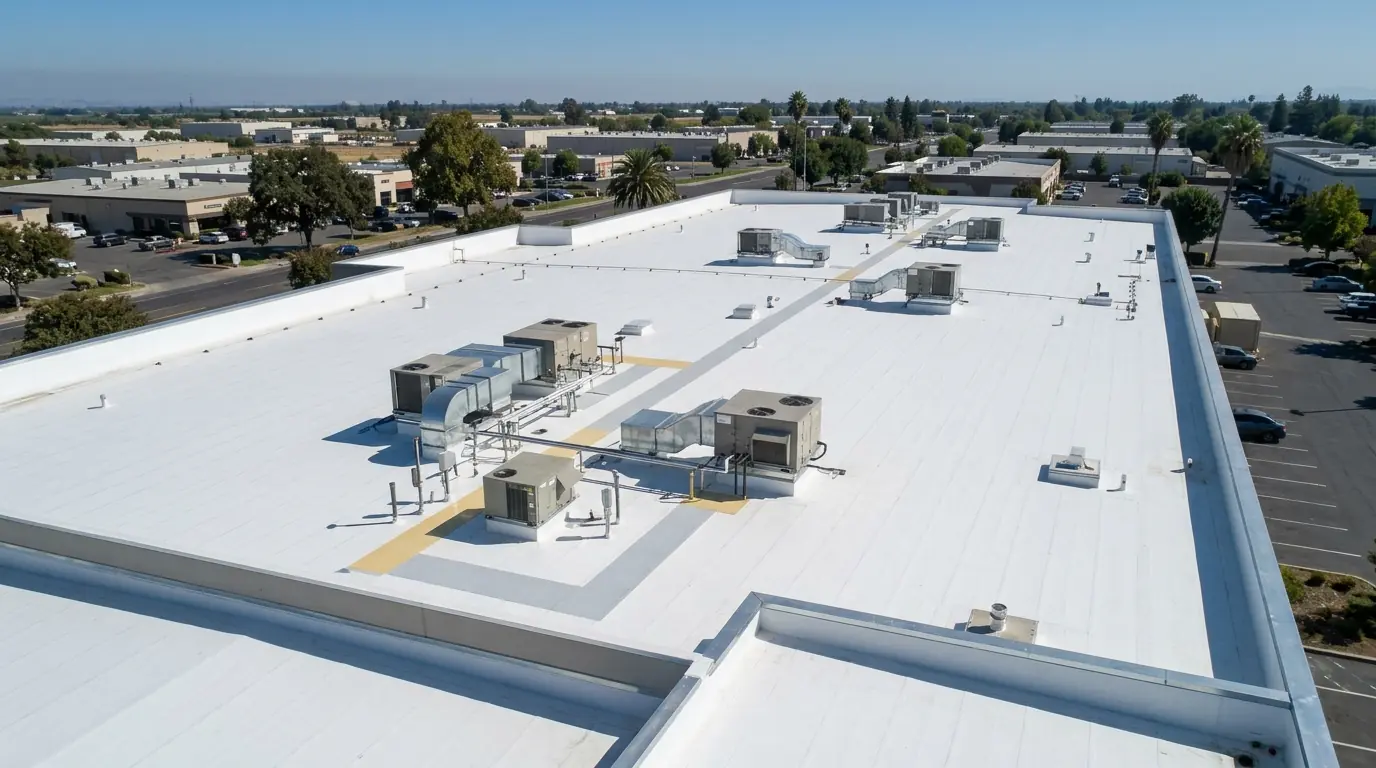
TPO is a white single-ply membrane with heat-welded seams, used on flat and low-slope roofs. In Sacramento, installed cost typically runs 6.10 to 12.60 per sq ft, and most commercial or residential jobs take one to five days. It reflects heat and can help meet cool roof requirements.
What this job involves
TPO stands for thermoplastic polyolefin. It is a flexible sheet, usually 45, 60 or 80 mils thick, that comes in wide rolls. Installers overlap the sheets and weld the seams with hot air, which fuses them into one continuous layer. The white surface reflects sunlight, so the roof stays cooler than dark membranes, which matters for cooling costs in Sacramento summers. That makes it popular on larger buildings with rooftop equipment that needs steady cooling.
TPO can be mechanically fastened, fully adhered or ballasted, depending on the deck and building. It is common on strip malls, warehouses, offices and an increasing number of residential flat roofs. Quality varies between manufacturers and thicknesses, so product choice matters. We install TPO as part of a full system with insulation, flashing and edge metal, and can compare it against spray foam and coatings for your building. We explain every option plainly.
When TPO is a good fit
TPO's white surface reflects sunlight, lowering roof temperature and helping with Title 24 cool roof compliance where it applies. That also cuts cooling costs.
Roofs with slopes too shallow for shingles or tile work well with TPO, as long as drainage is set up properly.
Aging layered roofs with leaks and alligatoring are often replaced with TPO for lighter weight and easier repairs. It is also lighter than gravel roofs.
Roofs with HVAC equipment need a membrane that handles foot traffic and can be repaired easily after service work. Equipment pads protect high-traffic paths.
TPO is generally lower cost than many alternatives while offering decent lifespan when installed correctly. It also installs faster than layered systems, which can cut labor costs.
Heat-welded seams are stronger than glued or taped seams when done well, and can be tested with a probe. Probe checks catch cold welds early.
How TPO is installed
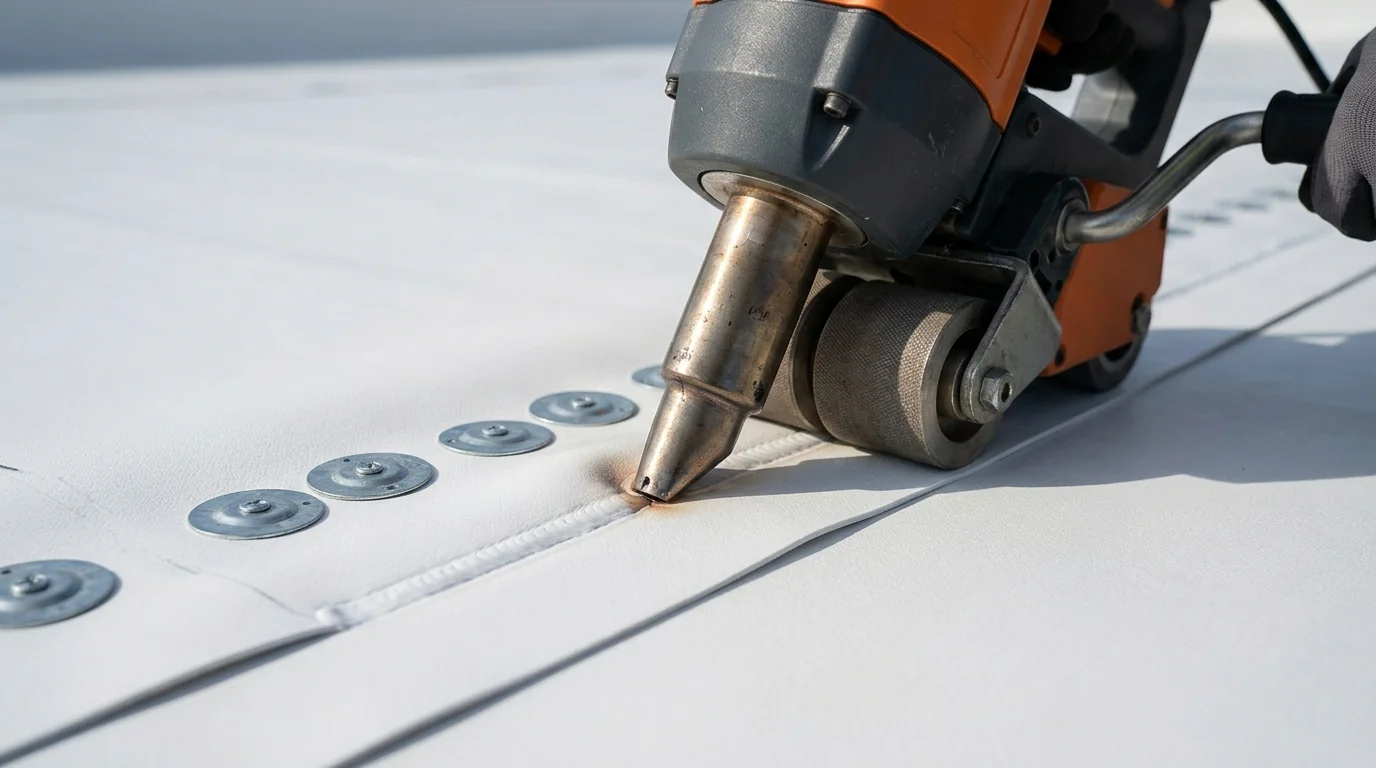
After tear-off and deck repair, we install insulation boards, usually polyiso, in layers with staggered joints. The TPO sheet is then rolled out and either mechanically fastened with plates and screws, or fully adhered with bonding adhesive. Adjacent sheets overlap by a few inches, and the seam is heat-welded with an automatic welder along the field and a hand tool at details. Walls, curbs and penetrations get flashing in the same membrane, welded in place. We pull a few welds apart during the job as a check on technique.
- Mechanically fastened systems use screws and plates in seam laps
- Fully adhered systems bond to the insulation with adhesive
- Heat-welded seams get probe-tested for gaps
- Flashing is TPO, not tar or generic caulk
Thickness, color and quality
TPO comes in 45, 60 and 80 mil. We generally recommend 60 mil for most roofs and 80 mil for heavy traffic or longer warranty goals. White is standard and offers the best reflectivity. Tan and gray are available but reflect less. Not all TPO is equal, as formulations vary by manufacturer, and some early-generation products shrank or cracked. We use established manufacturers with proven field track records. Manufacturer warranty terms vary by product and thickness, and typically require installation to their specifications.
Mistakes to avoid
Common problems include cold welds from rushed or wrong-temperature welding, poor flashing at walls and curbs, and ponding that is never fixed. Walking on dirty TPO can also compromise future welds, so repairs need proper cleaning first. TPO is not ideal over certain old asphalt layers without a separation layer, since oils can degrade the membrane. If drainage is poor, adding tapered insulation is cheaper than redoing the roof later. We tell you what a fair fix would cost before we start.
Our process for tpo roofing
Six steps, in the order the crew does them on a Sacramento roof.
- Step 1Inspect and test
We check deck condition, drainage and existing roof layers, and take moisture readings to see what must be removed. We also photograph the roof before demolition.
- Step 2Tear off and repair deck
Old roofing comes off as needed, and damaged deck sections are repaired and cleaned. Wet insulation is marked for removal and replacement.
- Step 3Install insulation
Polyiso boards go down in staggered layers and are fastened to the deck, with tapered sections where drainage needs help.
- Step 4Roll and attach membrane
TPO sheets are rolled out and fastened or adhered, with correct overlaps and fastening patterns. Overlap widths follow the manufacturer's requirements for your product.
- Step 5Weld seams and flash
Seams are heat-welded with automatic and hand welders, and walls, curbs and penetrations are flashed in TPO. Welder temperature is adjusted for weather.
- Step 6Probe and inspect
We run a probe along the seams, check every detail, install edge metal, and clean the roof before handing it back.
What tpo roofing costs in Sacramento
A 4,000 sq ft commercial roof with 60 mil fully adhered TPO and new insulation commonly runs about 32,500 to 46,800.
- Thickness and attachment method
- Insulation and tapered slope work
- Roof size and rooftop equipment
- Number of walls, curbs and penetrations
Compare this job with others in the Sacramento roofing cost guide.
Sacramento conditions that matter
TPO suits Sacramento's hot, dry summers, since the white surface reflects sun and can cut rooftop temperatures, which helps with Title 24 cool roof requirements that may apply to some low-slope reroofs. Winter rain tests seams and drains, so we check slope and flashing carefully. It is common on strip centers, warehouses and offices in West Sacramento, Rancho Cordova and along Business 80, and on residential flat roofs in mid-century neighborhoods like Sierra Oaks. SMUD customers can also see cooling savings from a reflective surface. Cleaner roofs also reflect more heat.
Often paired with this service
Questions about tpo roofing
How do heat-welded TPO seams get tested?
After welding, we run a flat probe, like a screwdriver tip, along the seam edge. A properly welded seam resists the probe, while a cold weld lets it slip in. Any gap is cleaned and re-welded with a hand tool. Probing every seam is part of finishing the job.
Is 45 mil TPO enough, or should I pay for 60 or 80?
45 mil is acceptable for light-traffic roofs, but 60 mil is the common choice for better puncture and weld strength. 80 mil suits heavy foot traffic or longer warranty goals. Price differences are modest compared to the total roof cost. Price differences are modest on most roofs.
Can TPO go over my old roof?
Sometimes. If the existing roof is dry, flat and code allows another layer, a recover system with a separation board can work. Wet insulation or multiple layers need tear-off. We test the roof and explain the best method before starting. We also look at the roof's weight limits.
Why not just use a white coating instead of TPO?
A coating works on a sound roof that is mostly intact, and can cost less. TPO is better when insulation is wet or the membrane is failing. We offer coatings and foam as alternatives where they fit, and will say honestly which suits your roof.
How long does a TPO roof last in Sacramento?
Well-installed TPO commonly lasts about 15 to 25 years, depending on thickness, drainage and maintenance. Heat is a stressor here, and ponding water shortens life. Regular inspections and prompt repair of punctures help the membrane reach the upper end of that range. We also note drain upkeep tips.
Roof leaking, peeling or baking in the sun?
Call the 24/7 line. Tell us the roof type, where the water shows up or what the coating looks like, and we will tell you what we would check first and when a crew can be there.