Sealing the walls above the roofline
Parapet wall repair in Sacramento, CA
Your parapet walls are cracking, the cap is loose and water is running down the inside of the wall, even though the roof field looks fine.
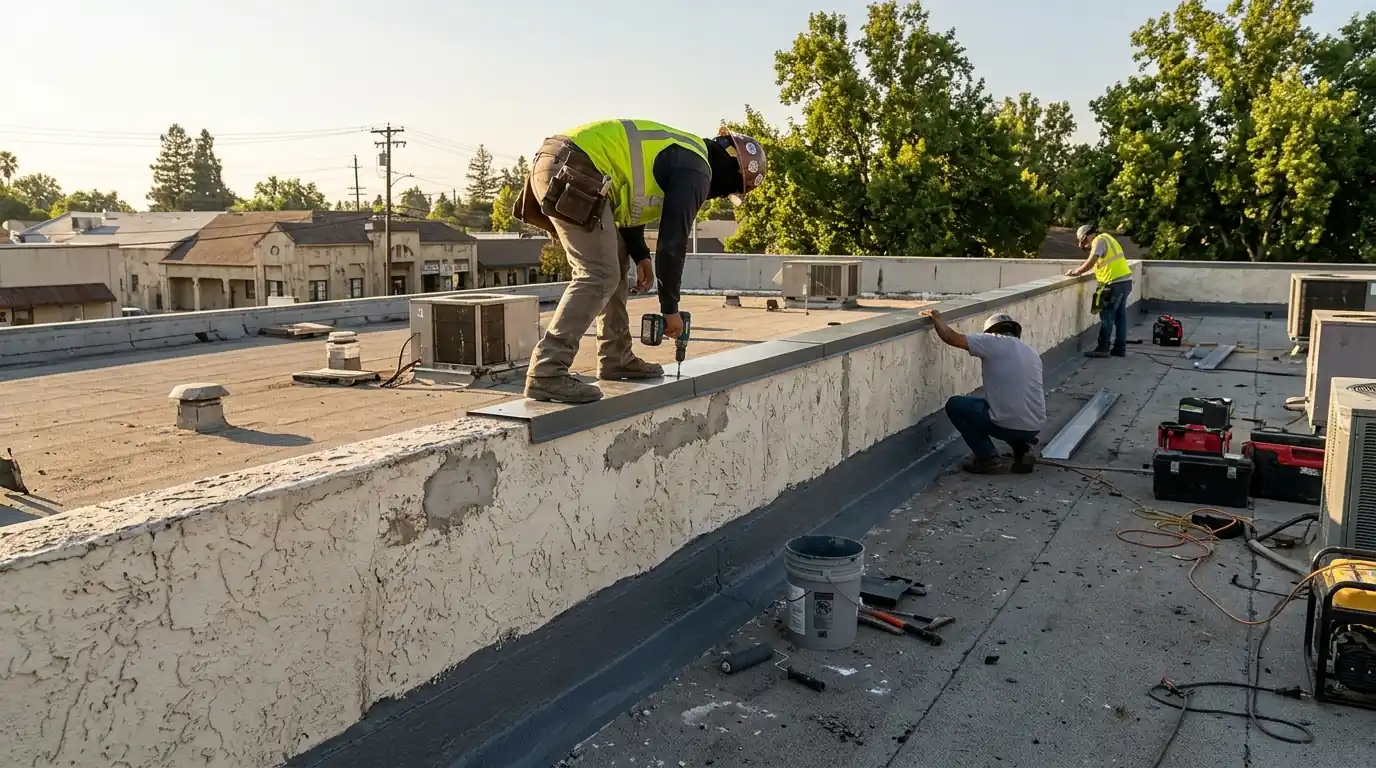
Parapet wall repair fixes the short walls around a flat roof edge by sealing cracks, repairing stucco or masonry, resetting coping and cap flashing, and coating the wall and its turn onto the roof. Typical Sacramento cost is 890 to 6,200 per job, depending on length, and most repairs take one to three days.
What this job involves
A parapet is the low wall that rises above the roof along the edge of a flat or low-slope building. It is exposed on three sides, to sun, rain and wind, and it connects the roof surface to the wall below. That makes it one of the most leak-prone parts of any roof. Water enters through the top, through cracked stucco or through the joint where roof membrane meets wall.
Parapet leaks are often misdiagnosed as roof leaks, because the stain appears at the ceiling edge or inside a wall. Fixing only the roof field does nothing. A good repair works from the top down: the cap or coping, the wall face, the base flashing and the roof membrane where it turns up the wall, since a failure at any one of these lets water in. That is why we survey the entire edge.
Signs your parapet walls need repair
Horizontal and stair-step cracks in parapet stucco let rain soak the wall core. Look near corners, the cap and where the wall meets the roof.
Metal or tile coping that has lifted, slid or rusted leaves the top of the wall open. Water then flows straight into the wall cavity.
Dark streaks running down the outside wall or brown stains on interior ceilings near the edge point to water entering at the parapet.
Roofing that has peeled or sagged where it climbs the parapet leaves an open gap. Base flashing must be re-adhered or replaced.
Masonry parapets with soft mortar or spalled brick have absorbed water and may freeze or stress. Repointing and sealing is needed.
A parapet that bows or tilts may have rotted framing inside, or loosened ties. This is a safety concern and needs prompt inspection.
The top, the face and the turn-up
Parapet repair divides into three zones. The top is the cap or coping, which should slope slightly toward the roof and be sealed at joints. The face is the stucco, brick, block or siding on both sides of the wall. The turn-up is where the roof membrane runs up the inside face and is finished with base flashing and a termination. Most leaks trace to one of these. A cracked cap lets water in from above, cracked stucco lets it in from the sides, and a failed turn-up lets it in at the base. We check all three, because fixing only one leaves the others to keep leaking. The sequence matters: repair the wall, then flash, then coat, so each layer lands on a sound surface.
Materials and repair methods
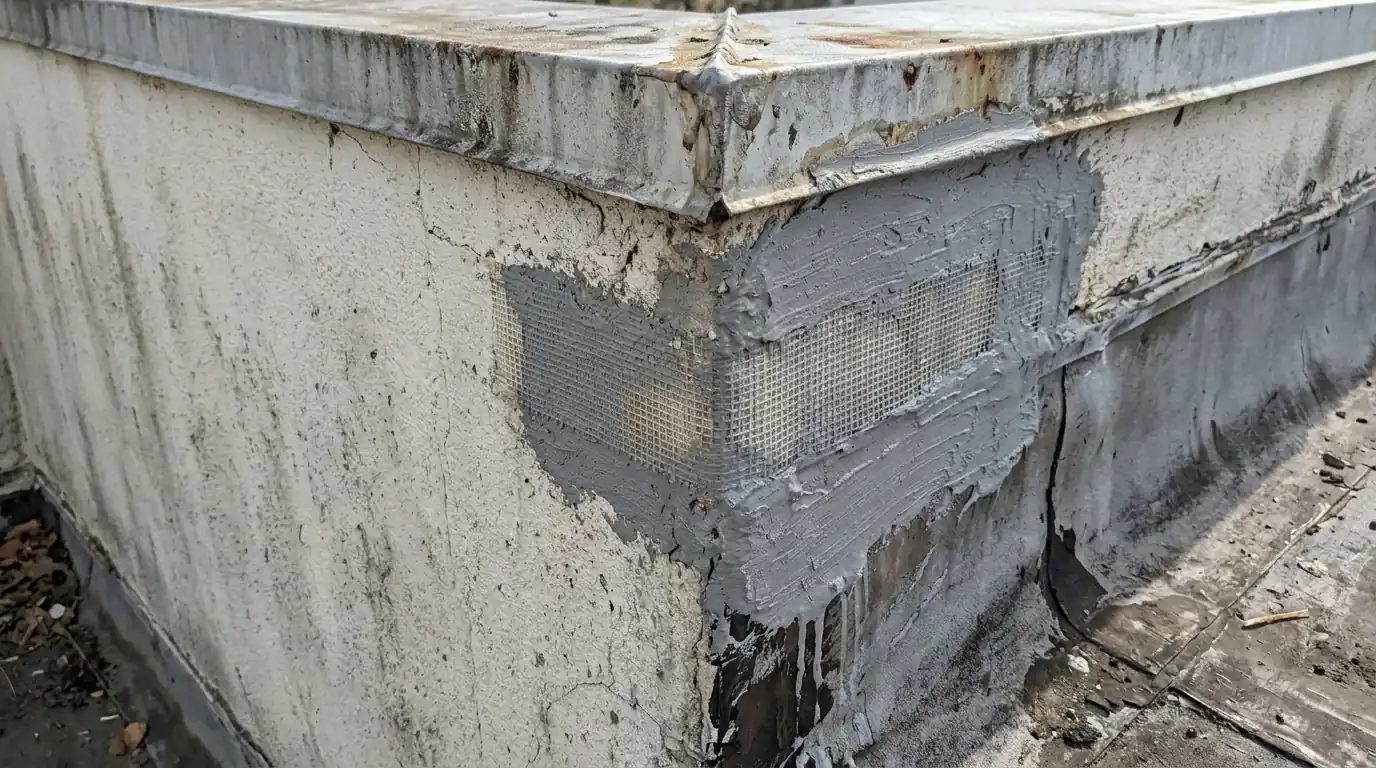
Cracked stucco is cut out, patched with matching mix and sealed with an elastomeric coating that bridges small movement. Wood-framed parapets with rotted sheathing need the damaged wood replaced. Masonry is repointed, and loose units are reset. Metal coping is refastened with sealed screws and cleats, or replaced with new, properly lapped sections. At the roof edge, the membrane is cleaned and re-adhered, and flashing is tied into the wall surface. Many parapets are finished with polyurethane or silicone coating that runs from the roof surface up the wall and across the top, forming one continuous membrane. This is often the most reliable repair for a wall with many small cracks.
- Cut out and patch cracked stucco
- Replace rotted wood sheathing
- Repoint masonry and reset loose units
- Refasten or replace coping with sealed joints
- Continuous coating from roof up wall and across top
When parapet problems signal bigger issues
A parapet that leans, bows or is crumbling needs more than sealant. Water may have rotted the framing inside, or earthquake and settlement may have loosened masonry. Tall parapets on older buildings can also be unbraced, which is a safety hazard in wind or a quake. We stop and recommend a structural check in those cases, and we do not coat over a wall that may be unsound. Another issue is scope. Large commercial parapets may need scaffolding, permits or coordination with a stucco or masonry contractor. We handle the roofing side, including flashing, cap and coating, and tell you plainly when another trade should look at the wall first, so repairs are done in the right order.
Our process for parapet wall repair
Six steps, in the order the crew does them on a Sacramento roof.
- Step 1Survey the whole edge
We walk the full roofline, tap the walls, check coping, cracks and flashing, and note anything that looks unsound or bowed.
- Step 2Repair the wall
Cracked stucco is cut out and patched, rotted wood is replaced and masonry is repointed, so the wall is sound before sealing.
- Step 3Reset cap or coping
Coping and cap flashing are refastened or replaced with sealed laps, sloped to shed water toward the roof. Coping and cap flashing are refastened or replaced with sealed laps, sloped to shed water back toward the roof surface.
- Step 4Flash the turn-up
Roof membrane is cleaned and re-adhered at the wall base, and base flashing and termination bars are installed and sealed.
- Step 5Prime and coat wall
A primer goes on where needed, then a continuous coating covers the wall face, top and roof turn-up to the target mil thickness.
- Step 6Inspect and water test
We check every joint and corner, water test where practical, and clear the roof edge and scuppers before we finish.
What parapet wall repair costs in Sacramento
Repairing and coating about 120 linear feet of stucco parapet with a new cap seal typically costs near 3,400 to 4,900.
- Length and height of parapet
- Wall material and damage
- Coping or cap replacement
- Scaffold or lift access
Compare this job with others in the Sacramento roofing cost guide.
Sacramento conditions that matter
Parapets are everywhere on Sacramento commercial buildings and many mid-century flat-roof homes, from strip centers along Fulton Avenue to office blocks in Midtown. The heat swings of a valley summer open stucco cracks, and then November through March rain soaks them. Tule fog adds moisture that lingers on north-facing walls. Stucco parapets are especially common on 1950s to 1970s buildings. Seismic bracing of tall unreinforced parapets is a code concern in some jurisdictions, so ask about local requirements. Roofs near the foothills may also fall under wildfire-zone material rules, which can affect coping and coating choices.
Questions about parapet wall repair
Why does my parapet leak when the roof does not?
Parapets are exposed from the top and both sides, so water can enter through cracks, coping and stucco without ever touching the roof field. It then runs down inside the wall and shows up at the ceiling edge. The repair has to seal the wall, not just the roof surface.
What is coping and why does it fail?
Coping is the cap on top of a parapet, usually metal, tile or concrete, that sheds water off the wall. It fails when joints open, fasteners rust or sections slide. Heat movement and wind loosen it over time. Sealed laps and proper slope toward the roof keep water out.
Can stucco cracks in a parapet just be caulked?
Caulk helps for hairline cracks, but it usually fails within a season or two in valley heat. A better repair cuts out wider cracks, patches them, and covers the wall with an elastomeric or polyurethane coating that stretches with movement and gives a continuous seal.
Do parapet repairs need permits?
Minor sealing and coating usually do not, but replacing large wall sections, structural work or seismic bracing can. Rules differ by city and county. We tell you what our part of the job involves, and recommend checking with your building department for any wall or structural work.
How do you waterproof the joint where roof meets wall?
We clean the membrane, re-adhere it to the wall, then install base flashing with a termination bar sealed at the top. Fabric and sealant or coating cover the joint. Since this transition moves with temperature, a flexible reinforced seal lasts longer than rigid caulk. Termination height matters.
Roof leaking, peeling or baking in the sun?
Call the 24/7 line. Tell us the roof type, where the water shows up or what the coating looks like, and we will tell you what we would check first and when a crew can be there.