Foam over the old roof or tear it off? How to decide
Spray foam can go straight over many sound existing roofs, which saves landfill, labor and mess. This guide explains what has to be true about the old roof, and when tearing off is the better call.
Updated November 2026, 6 minute read
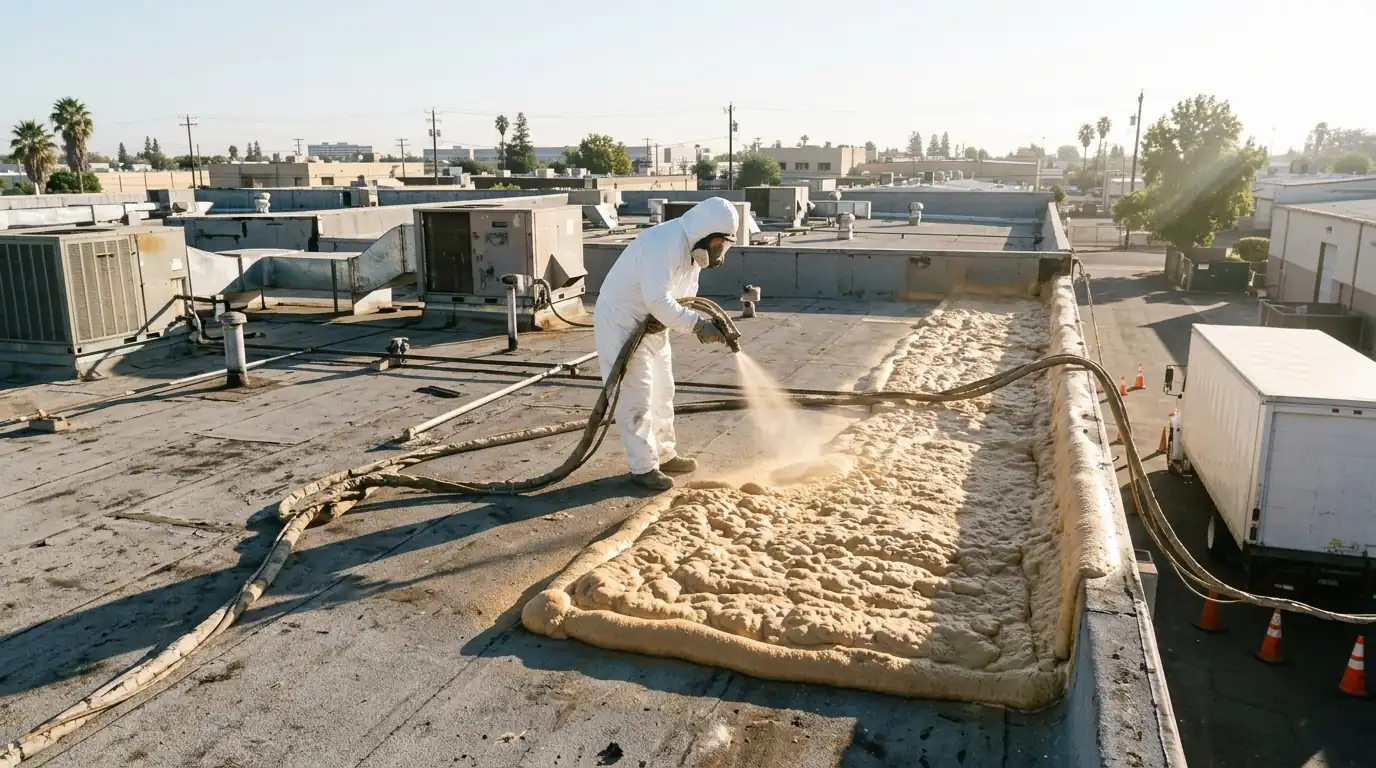
- Foam needs a dry, sound, clean substrate, not a perfect one.
- Wet insulation is the main reason a recover fails, so test for it.
- Tear-off makes sense when the deck or insulation is wet or rotten.
- A recover skips landfill costs and keeps the building dry during work.
Why foam can go over an old roof at all
Spray polyurethane foam is applied as a liquid that expands and bonds to whatever it is sprayed on. It does not need fasteners or hot asphalt, and it fills low spots and seams as it cures. That is why it works as a recover system over built-up roofing, modified bitumen, old foam, concrete, metal and some single-ply membranes. Roofing-grade foam is typically sprayed at about 2.7 to 3.0 pounds per cubic foot, which is firm enough to walk on once it is coated. Because foam is sprayed in place, it also wraps around curbs, pipes and corners without the cut seams a sheet membrane needs. On a roof full of penetrations, that alone can decide the question, since every seam is a place a leak can start later.
The old roof becomes the substrate. If the substrate is dry, attached to the deck and clean, the foam sticks to it and the new system seals the whole surface in one monolithic layer. If it is not, the foam is only as good as what is underneath. The finished system is usually a coating over foam over the old roof, so you gain insulation, slope and a fresh waterproof skin in a single visit, without a dumpster in the parking lot.
The questions that decide it
Three things matter more than the age of the roof. First, is the existing insulation or membrane wet? Trapped water under foam turns to vapor in a Sacramento August and pushes up blisters. Second, is the roof still attached to the deck, or is the membrane loose and sliding? Third, is the deck itself sound, with no soft plywood or rotted boards? Moisture is also the reason the age of the roof matters less than people think. Insulation that has been wet for years loses most of its R-value and can hold water like a sponge, and foam sprayed over it will not dry it out. Those areas have to be found before any quote means much.
A roof that is 25 years old but dry and tight is often a better candidate than a 12-year-old roof that has been leaking quietly into its insulation. Age tells you little. Moisture tells you almost everything. If a roofer offers a price over the phone without asking about leaks, past repairs or the layers underneath, treat that number with caution. Recovers go wrong at the assumptions, not at the spray gun.
- Dry insulation and membrane across the whole roof
- Membrane attached to the deck, not loose or bubbled
- Deck firm underfoot with no soft or sagging areas
- Drains, scuppers and flashings that can be raised or rebuilt
- No more than a modest amount of old patching compound or tar
How to find out if the roof is wet
There are three common checks. An infrared scan, done at dusk after a hot day, shows warm wet areas that hold heat longer than dry insulation. A nuclear or capacitance moisture meter confirms those readings. A core cut, a small round sample taken through every layer, shows what is actually there, including layer thickness and any dampness. Infrared works best on dry, clear days with a big temperature swing, which is common in Sacramento from late spring through fall. On a foggy winter morning the scan can be unreadable, so timing the inspection matters.
The usual approach is to scan first, mark suspect areas, then cut cores in a few of those spots and a few dry ones for comparison. Each core hole gets patched with foam and coating, so the roof is left watertight. Skipping this step is the most common way a recover goes wrong. Cores also settle a different question: how many layers are up there. Some flat roofs have two or three older systems stacked together, and the answer changes both the weight and the plan.
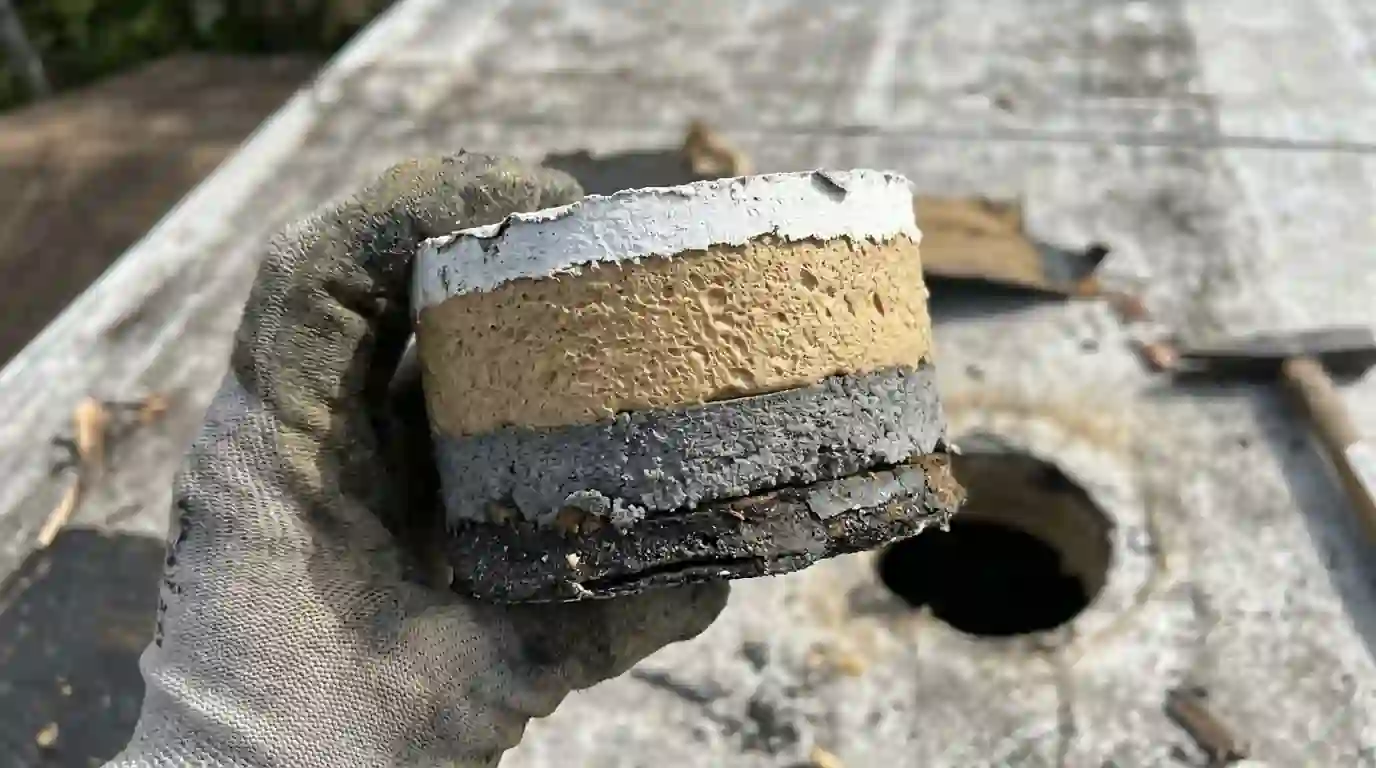
When tearing off is the better choice
Tear-off wins when the moisture is widespread, when the deck has rot, or when the roof has several layers already and the weight and thickness are a concern. It also wins when the existing roof is a type foam does not bond to well, such as loose gravel over a failing base that cannot be cleaned, or a shingle roof with heavy curling. A third case is a roof with many layers of old gravel and asphalt, where the bond between layers is weak. Foam sprayed over a poorly attached stack can lift with the layers beneath it, so the weak stack is removed down to something solid.
In those cases we remove the failed material down to a sound deck, repair any dry rot, and then spray fresh foam directly on the deck. You still end up with a foam roof, just without the old layers underneath. Partial tear-off is common too: cut out only the wet sections, patch with new insulation, and recover the rest. Tear-off in sections also keeps the building protected. Crews open only what can be dried in and foamed the same day, and tarp the rest if the sky changes. That is slower than ripping the whole roof, but it is far safer in November.
What each path typically costs in Sacramento
A foam recover over a dry, sound flat roof, including one to two inches of foam and a silicone or acrylic top coat, commonly runs from about 5.35 to 8.90 per square foot in the Sacramento area. A tear-off adds labor, dump fees and deck repair, often pushing the total toward 8.20 to 13.60 per square foot. These are typical ranges, and the real price comes after the roof is inspected. Your own plans matter too. A building you will keep for twenty years justifies spending more to start clean, while a property you may sell soon may only need the recover that stops leaks and shows well on an inspection.
Recovering also keeps the building dry while work happens, which matters for offices, restaurants and homes with a flat roof over living space. A full tear-off exposes the deck for a day or more, and our short winter rain windows make that riskier from November through March. Dump fees, dry rot repair and the lost day or two of work all stack up on a tear-off. Ask for both numbers if the roof is borderline, so you can see what the removal adds, rather than hearing only one option.
A simple way to make the call
Start with a moisture scan and a few cores. If the results are mostly dry, recover. If a third or less of the roof is wet, cut out those areas and recover the rest. If the majority is wet or the deck is soft, tear off. That order of decisions keeps you from paying to remove a roof that did not need removing, and from coating over one that did. Whichever way the results go, ask for the scan map and the core photos. A roofer who has actually tested the roof can show you where it is wet and where it is dry, and that evidence is what makes the recommendation worth trusting.
We answer 24/7. If the roof is a mix, a partial tear-off and a full foam recover is common, and it lets you pay only for the removal the roof actually needs. If you are weighing the two options on a Sacramento roof and want a straight answer after an inspection, call Mountainside Foam & Coating at (916) 963-8097.
Questions readers ask
Can foam be sprayed over a roof that has already been patched with tar?
Usually yes, if the tar is cured and not soft or oily. Heavy tar buildup can bleed through, so crews scrape high spots, clean the surface and sometimes apply a primer. A small adhesion test patch tells you whether the foam will grip before the full roof is sprayed. Sometimes crews will also lightly scarify glossy or oily surfaces, or apply a primer, to help the foam grip.
How thick should foam be when it goes over an existing roof?
Most recovers use about one to two inches. That adds roughly R-6 to R-6.5 per inch and builds slight slope to help water move. The final thickness depends on how uneven the old surface is and how much insulation value you want. A typical answer is yes, and a typical failure is a roof where everyone assumed it was dry and no one checked.
Does recovering with foam add much weight to the roof?
Very little. Roofing foam weighs roughly 3 pounds per cubic foot, so two inches adds well under a pound per square foot before coating. That is far lighter than adding a second layer of gravel or tile, so most existing structures handle it without concern. Rural roofs and small ones may skip the infrared and go straight to cores, since a handful of samples can cover a few hundred square feet well enough.
Roof leaking, peeling or baking in the sun?
Call the 24/7 line. Tell us the roof type, where the water shows up or what the coating looks like, and we will tell you what we would check first and when a crew can be there.